


This year the Primorsky Aquarium celebrates its 10th anniversary, and we are launching a series of articles about the people who have made significant contributions to its work. One of them is the Principal Fish Pathologist Mariia Popova.
The Fish Pathology Department works in close collaboration with other departments to safeguard the health of aquatic organisms. Mariia Iurievna Popova, the Aquarium's Principal Fish Pathologist, is sharing her journey into the profession and her work as “Doctor Dolittle for fish” at the Primorsky Aquarium.
M.Iu.: “I was drawn to biology by a calling. In secondary school, I was in a biology and chemistry specialization class and, before applying to university, I was wavering between biology and medical majors. Finally, I went to the Far-Eastern State University (=former name of the Far Eastern Federal University) to study biology and I chose fish pathology as my specialty. So, I kind of combined my passions: medicine and biology.”
Popova’s graduation fell on the difficult 1990s, the time of science decline, and the young specialist had to forgo her planned postgraduate education and start working outside her field of study. In 2003, she got an opportunity to return to her beloved occupation: she found a job at Primorrybvod (=Primorsky Administration for Fish Farming and Fishery Protection). Mariia Iurievna worked there as Head Fish Pathologist and supervised the Barabashevskii and Riazanovskii fish hatcheries. Over the years, she acquired vast practical experience both in production activities and in management and organization. Perhaps, her destiny had been specifically preparing her for the Aquarium.

M.Iu.: “The offer to work at the Aquarium came in late 2015, from Dmitrii Leonidovich Pitruk, the then Deputy Director for Science.
The Primorsky Aquarium did not have any fish pathology department at the moment. I was to organize it and to lead all the work. After some consideration, I agreed. Working in salmon hatcheries is quite monotonous—it is the same fish species and standard procedures all the time. I was eager to learn new things and grow beyond myself. Understanding the serious undertaking ahead, I took to self-education, studying all available literature. On March 16, 2016, when animals started to arrive in large numbers, I began my work at the Primorsky Aquarium."
From the very first days, Mariia had to multitask: to organize work processes, to develop methodology and protocols, and to keep records of treatments and preventive measures. As mass deliveries of animals started, she often spent nights at the Aquarium. Her knowledge and experience multiplied by her personal qualities did their job: by the end of this hard period, everything operated like clockwork, all the arriving animals were accepted, sent to quarantine and provided with the necessary care.
M.Iu.: “The work at the Aquarium is multifaceted, which is the most interesting thing about it. Different fish species living here require different conditions, they have different health issues and specific diseases. You need to constantly follow science news, learn new things and implement effective diagnostic methods. During the busy first years, when huge numbers of animals came all at once, we had to do everything quickly, gathering information and taking decisions on the spot. But we managed, we jumped straight into deep water and started swimming. Professional training and an opportunity to share experience with our colleagues from Saint-Petersburg, arranged by the Primorsky Aquarium’s executives, proved to be of tremendous help.”
The days of setup and initial mass deliveries of animals are long gone. Today, the Aquarium lives a stable and well-ordered life, which would be impossible without persistent efforts of both fish pathologists and other specialists. Process organization and collaboration among team members play a huge role in the Aquarium’s work.
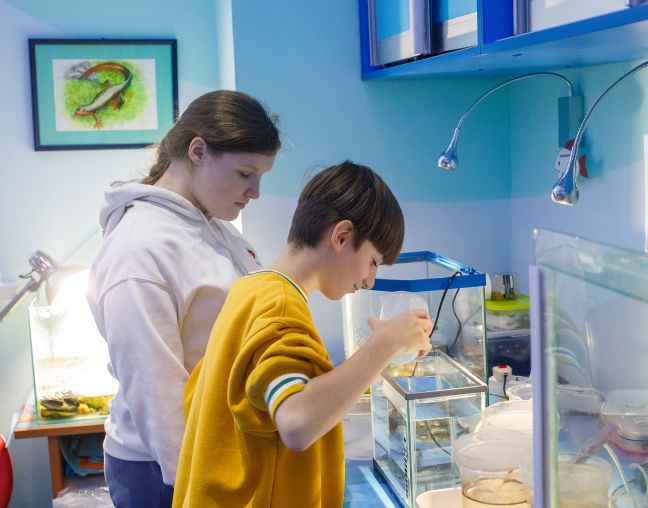
M.Iu.: “When new animals arrive, they go into quarantine. We examine them every day, sometimes up to three times a day. The routine procedures include taking skin scrapes, sampling gill mucus and carrying out other tests. Based on the results, we prescribe treatments and give vitamins and medications, for example, to eliminate parasites. As the quarantine finishes, the animals move to the exhibits or remain at the Science and Acclimation Building for breeding or as a replacement stock. They are not left unattended afterwards and regularly receive preventive treatment, for example, vaccination or immune-boosting vitamins and minerals.
To ensure fish welfare, it is necessary both to set up all work operations and to build good relationships with the colleagues. The main partners for us are our aquarists. We regard them as “parents” of our charges. We also work in close collaboration with water chemists and microbiologists. The health of the fish depends directly on the water quality, and one of the main threats for them is bacterial infections.”
After moving to the exhibits from the Science and Acclimation Building, the animals continue to be under a close supervision of fish pathologists. Daily examinations and side-by-side work with the aquarists enable them to effectively monitor the health of the aquarium’s inhabitants and to take necessary measures in a timely manner.


M.Iu.: “All these things would be impossible without our team. Our human resource strategy is to attract university students and develop their abilities and skills through on-the-job training. The Fish Pathology Department specialists are highly qualified: they are capable of taking on a certain share of administrative and logistical tasks, and all the necessary procedures have been fine-tuned. This allows me to dedicate a significant portion of my time to the animals, and not get bogged down in paperwork.”
In the following publications, we will continue telling stories about the people whose work, invisible to the general public, helps our fish and other animals to be healthy and feel well and creates the beauty and wonders of the underwater exhibits that we offer to our visitors.
Join us on Rutube.
.jpg)