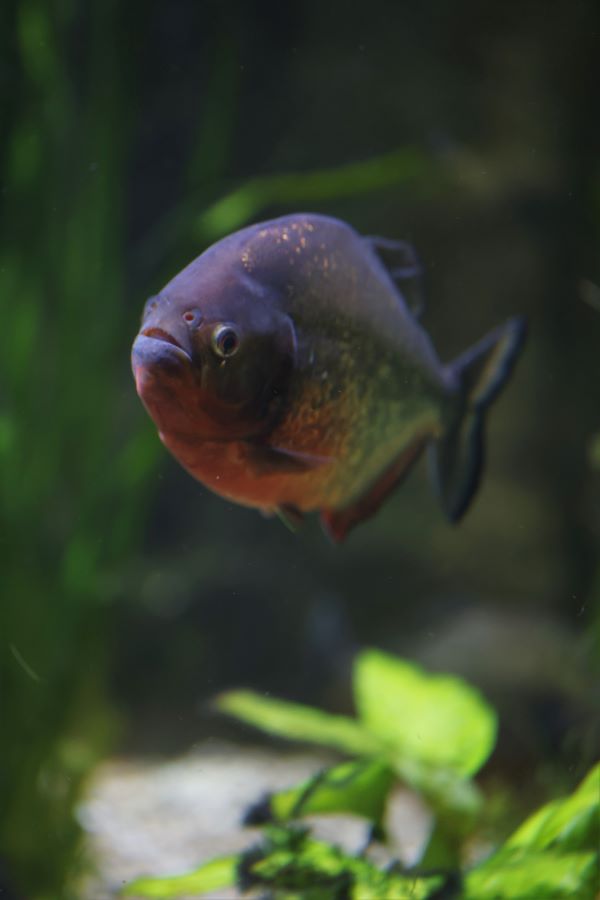
A pair of redbelly piranhas (Pygocentrus nattereri) has spawned in one of the tanks of the Tropical Rain Forest exhibit. Aquarists described the event as “uncommon.”
Captive breeding of piranhas is infrequent even in public aquariums. Piranhas require spacious tanks with a volume of at least several hundred liters. These fish are highly territorial and aggressive, thus smaller aquariums make pair-bonding impossible. Moreover, spawning depends critically on the water parameters that have to simulate the annual flood cycles of their habitats.
Redbelly piranhas are relatively small fish, with a maximum length of 50 cm and a weight up to 3.9 kg. They inhabit the entire Amazon River System and are widely distributed across tropical freshwaters of South America. The fish reach sexual maturity at an age of 12–18 months.
Piranhas have gained a notorious reputation due to mass culture portraying them as ruthless killers that instantly attack anyone who dares enter the water. However, scientists debunk this popular myth. Of course, large shoals of several hundred individuals can be dangerous to large animals and humans, but piranhas primarily feed on other fish, invertebrates and carrion found in the water and can adapt to various foods. Additionally, these fish are not apex predators in their habitats as they are preyed upon by caimans and Amazon river dolphins.
Piranhas are harmless in aquariums if they are kept in good condition. They are rather smart, quickly get used to their owners and start taking food. They remember feeding times and recognize those who feed them. Aquarists give the piranhas whole fish, including pollock, and they eat this food with relish.
To start the breeding process aquarists had to adjust water quality parameters to those found in the natural habitats of this fish. By manipulating water pH within the specified range, they simulated the rainy season. In the first stage, they introduced plant biomass, primarily tree leaves, into the water to lower the pH and then sharply raised it by adding specially prepared and cleaned scallop shells.
Mimicking seasonal flood pulses managed to trigger the spawning. Usually, the process begins with the building of a nest, which lasts 1–1.5 weeks. The fish clear an area on the bottom, “mowing down” vegetation and driving other piranhas out of their territory.
To date, one pair of piranhas has spawned successfully in the Tropical Rain Forest exhibit.

The male is now guarding the eggs, allowing no one near them, not even the female. Incubation may take from 2 to 15 days, and after hatching, aquarists will transfer the fry to a separate aquarium for rearing, where they will receive live food appropriate to their size.
As Artem Baranov, Head of the Tropical Freshwater Species Department, explained, even if the fry do not survive, spawning is beneficial for the fish themselves as it has a rejuvenating effect on their reproductive system, which prevents stasis in the body and reduces the risk of diseases.
The fry may hatch very soon, and those curious who wish to see a piranha guarding a clutch of eggs are welcome in the Tropical Rain Forest as soon as possible.